





Paper Weight Conversion: GSM to LBS
In printing, understanding paper weights is like learning a second language—it’s key to choosing the right paper for your project. Whether you’re printing books, magazines, catalogs, notebooks, card decks, or other printed materials, knowing paper weight ensures your final product looks, feels, and performs exactly as intended. This guide breaks down the differences between GSM and pounds (lbs) and provides practical tools and reference charts to make converting between these units simple and accurate.
Paper Weight
Paper weight is also called “gram weight”. Paper weight refers to the mass per square meter of paper or cardboard, expressed in g/㎡. Paper weight is a measure that reflects the heaviness of paper. However, this measurement isn’t as straightforward as weighing a sheet on a scale.
Instead, paper weight is determined by the weight of a ream (500 sheets) in its uncut size, which varies depending on the type of paper. This is why you’ll often see paper described in terms like “54 lb” or “80 gsm.” The weight of the paper can influence many aspects of its performance, such as opacity, how it feels in the hand, and its sturdiness for tasks like mailing.
Paper Weight Conversion
Know about the paper weight and thickness conversion can help you determine the weight of a paper sheet of any size, gram weight and basis weight.
Converting between gsm, lbs, pt and mm is essential for anyone working internationally or with different types of paper. These conversions help us to compare paper types and ensure that we’re selecting the right weight and thickness for our needs. Let’s break down each type of conversion.
Convert gsm to lbs or lbs to gsm
To convert gsm to lbs or lbs to gsm, we need to identify the “basis size” of the paper we’re working with because lbs measurements are based on the weight of a ream of this size rather than a standard square meter.
Once the basis size is known, we can use a conversion chart or calculator to find the equivalent lbs.
GSM to Lb Formula
1 gsm = 0.676 lb Text paper. Multiply each gsm by 0.676.
1 gsm = 0.369 lb Cover paper. Multiply each gsm by 0.3695.
For example:
200gsm text paper = 135.2lb (200 x 0.676)
200gsm cover paper = 73.9lb (200 x 0.3695)
GSM to LBS & LBS to GSM Calculator and Chart
Easily convert between pounds (lbs) and grams per square meter (GSM) with our handy paper weight calculator. Whether you need to switch from lbs to GSM or GSM to lbs, this tool makes the conversion quick and accurate, helping you choose the right paper for your project.
You can also use the chart below to quickly convert from GSM to lbs or lbs to GSM.
Common Weight: GSM to LBS Chart
| GSM | Cover (lb) |
| 157 gsm | 58 lb |
| 200 gsm | 74 lb |
| 250 gsm | 92 lb |
| 300 gsm | 111 lb |
| 350 gsm | 129 lb |
| 400 gsm | 148 lb |
| GSM | Text (lb) |
| 70 gsm | 47 lb |
| 80 gsm | 54 lb |
| 100 gsm | 68 lb |
| 105 gsm | 71 lb |
| 120 gsm | 81 lb |
| 128 gsm | 86 lb |
| 140 gsm | 95 lb |
| 157 gsm | 106 lb |
| 160 gsm | 108 lb |
| 180 gsm | 122 lb |
| 200 gsm | 135 lb |
Common Weight: LBS to GSM Chart
| Cover (lb) | GSM |
| 60 lb Cover | 162 gsm |
| 80 lb Cover | 216 gsm |
| 90 lb Cover | 244 gsm |
| 100 lb Cover | 271 gsm |
| 110 lb Cover | 298 gsm |
| 120 lb Cover | 325 gsm |
| 130 lb Cover | 352 gsm |
| Text (lb) | GSM |
| 50 lb Text | 74 gsm |
| 60 lb Text | 89 gsm |
| 70 lb Text | 104 gsm |
| 80 lb Text | 118 gsm |
| 90 lb Text | 133 gsm |
| 100 lb Text | 148 gsm |
| 120 lb Text | 163 gsm |
| 130 lb Text | 192 gsm |
| 140 lb Text | 207 gsm |
What’s GSM Meaning
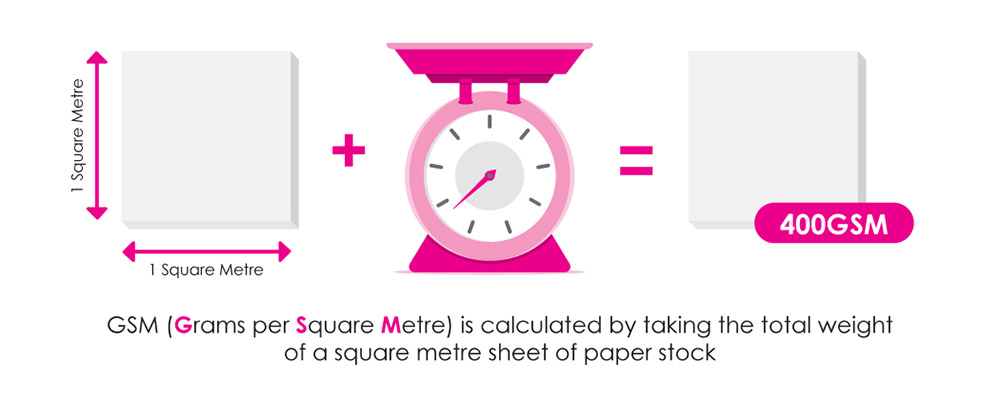
GSM is an acronym for grams per square meter and is an international standard for measuring the weight of paper. When we talk about what is gsm paper, we’re referring to the weight of the paper in terms of how much a single sheet of one square meter weighs in grams.
GSM is a very straightforward measurement because it doesn’t vary with the sheet’s size. This means that whether you have a tiny A5 sheet or a large A0 poster, if they’re both 80 gsm paper, they weigh the same per square meter.
GSM provides a precise and consistent method for comparing the weight and, to a certain extent, the thickness of different types of paper.
What’s LBS Meaning
Lbs, or pounds, is the weight measurement used in the United States and is based on the weight of 500 sheets (a ream) of the basic size of a particular paper type.
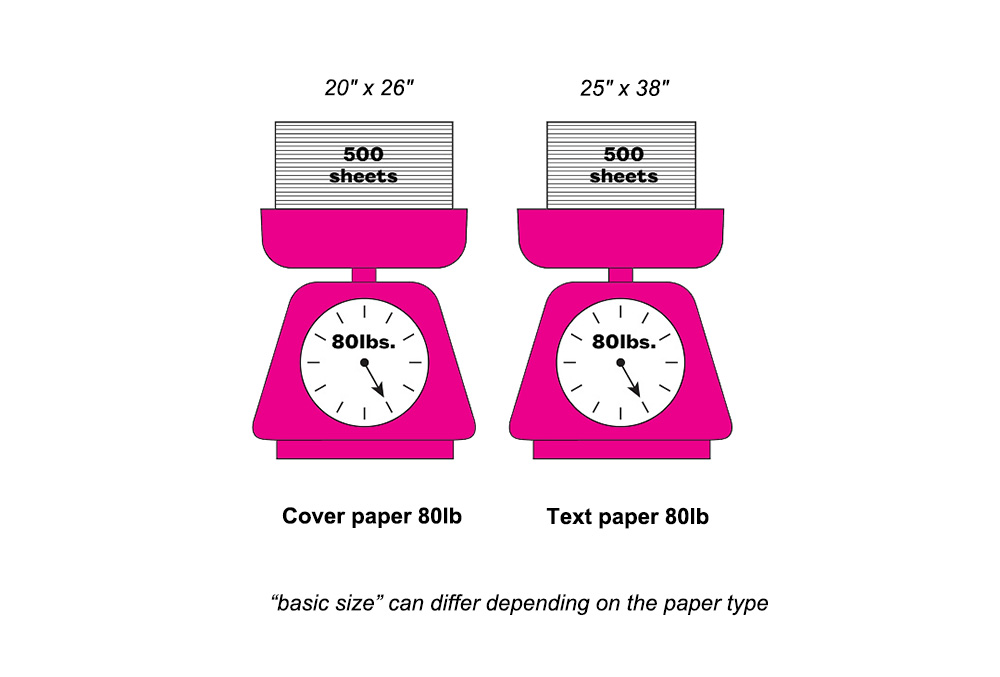
For example, if the paper is described as “100 pounds” or “100#” means that the paper weight is 100lb. It’s important to note that the “basic size” can differ depending on the paper type, so a ream of cardstock may have a basic size different from a ream of text paper.
| Paper Types | Standard Size |
| Bond paper | 17″ x 22″ |
| Cover paper | 20″ x 26″ |
| Text paper | 25″ x 38″ |
| Index Bristol | 25.5 x 30.5″ |
| Mill Bristol | 22.5 x 28.5″ / 22.5 x 35″ |
| Newsprint | 24″ x 36″ |
For example:
The basic size for bond paper is 17″ x 22″, and if 500 sheets at that size weight 80 pounds, the paper is classified as 80 lb.
The basic size for cover paper is 20″ x 26″, and if 500 sheets at that size weight 80 pounds, the paper is classified as 80lb.
The basic size for text paper is 25″ x 38″, and if 500 sheets at that size weight 80 pounds, the paper is classified as 80lb.
The basic size for Index Bristol is 25.5″ x 30.5″, and if 500 sheets at that size weight 80 pounds, the paper is classified as 80lb.
The basic size for Mill Bristol is 22.5″ x 28.5″ and 22.5″ x 35″, and if 500 sheets at that size weight 80 pounds, the paper is classified as 80lb.
The basic size for Newsprint is 24″ x 36″, and if 500 sheets at that size weight 80 pounds, the paper is classified as 80lb.
This measurement can be confusing because the basic size differs among types of paper, which is why GSM is often used alongside LBS for clarity.
Common Usages for Different Weight
Understanding common paper thicknesses makes it easier to select the right paper for any project.
Thin papers (30–50 gsm): Ideal for Bibles, religious texts, and dictionaries.
Lightweight papers (70–100 gsm): Perfect for novels, notebooks, thicker books and catalogs.
Mid-weight papers (120–140 gsm): Great for coloring books, planners, journals, and similar projects.
Thicker papers (157–200 gsm): Used for posters, flyers, children’s books, art books, photo books, and high-end marketing materials.
Heavy papers (250–350 gsm): Common for book covers, flashcards, game cards, calendars, and cardboard boxes.
C1S cardstock: 10–12 pt for paper bags, greeting cards, postcards, and thank-you cards; 12–16 pt for board books, heavy covers, flashcards, and luxury packaging.
Navigating paper weight involves understanding GSM, and lbs, and knowing how to convert between them. Whether you’re preparing business materials, managing a print project, or simply exploring paper options, these insights help you make informed choices and ensure a professional, high-quality final product.
For any questions about your printing project, contact our experts today.